

About me
Personally

I have never built my life or career inside a single country, discipline or institutional system—and that is one of the most useful things about me. I am an interpretative analyst, institutional strategist and programme architect. In simpler terms, I make sense of messy realities. I find the underlying structure in scattered information, competing ideas and organisational problems, then turn that understanding into strategies, decisions and programmes that can work in practice.
A perspective shaped across countries
I have studied and worked across Germany, the United Kingdom, Spain, China and Thailand, while building a career that reaches across the wider Asia-Pacific region. This has given me more than international exposure. It has taught me that what appears normal, obvious or universally correct in one setting may simply be local convention in another.
Working in German, English and Spanish—and having also studied Chinese—has reinforced that translation is never only about words. Ideas carry assumptions about authority, responsibility, evidence, time and social relationships. Understanding those differences helps me translate not only between languages, but also between national cultures, professional communities and institutional levels.
Having built most of my career in Thailand while working with countries across Asia-Pacific has also given me a valuable position between worlds. I understand the ambitions and language of international organisations, but I also see what happens when global frameworks encounter national institutions, local capacities and everyday implementation.
A career across disciplines and institutions
My education crosses social sciences, Latin American studies and environmental studies. Each field trained me to ask different questions: how people behave within social structures, how history and culture shape institutions, how policy ideas travel, and how scientific evidence interacts with technology, society and political choices.
My professional work has taken me through United Nations bodies, research institutes, foundations, universities and smaller organisations. I have seen institutions from different vantage points—from operational delivery to regional analysis, programme leadership and direct executive advice. That range helps me understand how decisions made at one level are experienced by the people expected to implement them.
Much of my work has also involved significant responsibility without relying on formal hierarchy. Leading across countries, disciplines and organisational boundaries has taught me to create influence through sound analysis, clear expectations, credible evidence and structures that help people understand what must happen next.
Working as an embedded consultant has added another perspective. I have often been close enough to understand an institution’s daily realities while retaining enough distance to question its established assumptions. I pay attention to the difference between the formal organisation chart and the way decisions are actually made; between stated procedures and lived practice; and between professional status and demonstrated competence.
This has also made me attentive to how hierarchy, contract status, institutional tenure and professional language can influence whose knowledge is heard and whose contribution is recognised. Rather than making me cynical about institutions, it has strengthened my interest in building clearer, fairer and more accountable ones.
How I think and work
My advice begins with analysis. I examine the evidence, assumptions, incentives, responsibilities, resources and decision structures surrounding a problem before deciding what should be done. I am not interested in producing impressive-sounding ideas that collapse when they meet reality.
I am particularly drawn to problems that are complex, cross-sectoral or institutionally uncomfortable. These are often the situations in which the official explanation does not quite match what is happening, several parties hold different pieces of the answer, or everyone is busy without a clear connection between their work and the intended result.
I enjoy the moment when scattered facts begin to reveal a pattern and a previously unmanageable problem becomes something people can understand and act upon. Once the underlying problem is clear, I translate the diagnosis into practical choices: a stronger programme structure, clearer responsibilities, better evidence, a workable monitoring approach, more credible resource allocations or a decision that has been postponed for too long.
I am willing to question accepted terminology and established frameworks when their logic does not hold. This is not opposition for its own sake. It is a refusal to mistake repetition, institutional status or professional consensus for proof.
The thread connecting my work
My experience crosses education, climate, agriculture, youth inclusion, gender and sustainable development, including work with SDG and ESG frameworks. The breadth is not accidental, and it does not mean that I approach every subject superficially. The sectors change, but the analytical task remains remarkably consistent.
In each setting, I ask how goals, evidence, authority, people, resources and implementation fit together. I identify where those elements have become disconnected and develop a structure that reconnects them.
A conventional career can build deep familiarity with one settled system. Mine has developed portable judgement: the ability to enter an unfamiliar setting, understand its social and institutional logic, distinguish local habits from structural requirements, and determine what will genuinely work there.
That is the contribution I bring to organisations: analytical depth, comparative perspective and the ability to turn complexity into institutional direction.
Professionally
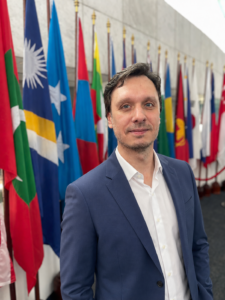
I am a senior programme architect, strategic analyst, and institutional systems specialist who turns complex agendas into workable structures, evidence systems, analytical outputs, and implementation pathways. I build the structure that lets broad agendas become practical work with clear goals, realistic indicators, reliable data, and roles that match real institutional capacity. I work with organizations that need to turn complex goals into workable systems, whether they are public, non-profit, research, or private-sector actors.
For more than a decade, I have worked across Asia-Pacific on the systems that sit behind public-purpose work: the analysis, structures, frameworks, and reporting that help turn ambition into something usable. My background grew out of social development, education systems, and SDG 4 monitoring, including education finance, data quality, and regional reporting, and has since expanded into climate, agriculture, and the practical evidence systems needed to support decisions and track progress.
My analytical work includes compiling and cleaning country data, creating descriptive statistics, comparing patterns across countries, interpreting education, finance, sustainability, and socio-economic indicators, and turning those findings into reports, charts, recommendations, and decision tools. My work has included shaping major regional education publications, producing descriptive analysis for policy-facing reports, rebuilding misaligned data-quality assessments for cross-country planning, turning activity-based proposals into results-based delivery systems, designing environmental education and sustainability programmes, synthesising more than 300 research sources into usable evidence, and advising senior leadership on institutional roles, proposal governance, and quality-control systems.
I am strongest when:
- objectives are messy
- institutions are fragmented
- evidence exists but is not yet usable
- strategies need to be translated into concrete structures
- roles, indicators, governance, and implementation logic need to be clarified
I am not mainly a subject-matter technician in one narrow silo. I am a cross-functional architect who connects strategy, evidence, governance, delivery, and learning. I bring order to chaos. I take scattered ideas, overbuilt or absent frameworks, messy data and seemingly non-related information and turn them into coherent systems, programmes, architectural frameworks, as well as decision-ready evidence-backed stories.
I am careful with claims, clear about evidence limits, and comfortable designing methods when no ready-made guidance exists. I will tell you what information-at-hand can support, what it cannot, and what would be needed to strengthen conclusions. That honesty protects your decisions later.
I typically sit between academic specialists, market experts, policymakers, and donors. I translate across disciplines and levels, and I build scaffolding people can keep using—templates, guidance, and results plans that make delivery possible.
Does it work? Why is this so?
These two questions are my fundamental thinking. I have a knack for ever improving products and procedures. Through a combination of strict logic and divergent thinking, I am capable of linking seemingly diverse information and crafting ideas into big picture plans. Learning about new subjects, untangling challenges and striving for efficient solutions are my engine.
Track Record
- Led a multi-country portfolio on greenhouse-gas reduction for agriculture across Southeast Asia, coordinating senior scientists.
- Authored the Asia-Pacific Education Financing report and the SDG 4 Midterm Review, shaping the outline, data work, cross-country analysis, and final narrative for 40+ countries.
- Delivered SDG 4 and socio-economic analysis for Asia-Pacific, pulling from international databases and household surveys for decision-making.
- Co-developed capacity-development programmes of varying scope and multi-year proposals in the 1.3–1.7M USD range, including full objectives, results-based logic, timelines, and budgets estimates for major donors.
- Crafted training materials for ministerial and partner audiences, collaborating with internal and external subject-matter experts and turning their inputs into structured guides and learning modules.
- Took over education data quality audits and rebuilt their comparability across 15 countries by matching criteria to evidence, creating a regional assessment that shaped programming.
- Reworked inconsistent cross-country evidence, categories, and source material into comparable analytical products that ministries, programme teams, and regional offices could actually use.
- Designed a national in-service teacher training monitoring framework with full indicator metadata, integrated by the ministry in Lao PDR.
- Reviewed 300+ scientific publications and built global bamboo carbon-sequestration scenarios.
- Coordinated multi-country data collection with ministries across Asia-Pacific, including follow-up and support.
- Supervised junior staff and senior external consultants on regional research, analysis, and reporting, including timelines and quality control.
- Produced policy and discussion papers, including education, gender, youth inclusion, digital skills, disability, and environmental themes.
- Carried out curriculum and policy analysis on ESD and GCED, creating a structured method and translating findings into programme directions.
- Presented to corporate audiences on using SDG indicators for social and environmental business practice, bridging ESG thinking.
- Interpreted education strategies, curricula, and policy documents across Asia-Pacific to identify what systems were prioritising, omitting, or reproducing in areas such as citizenship, sustainability, gender, and inclusion.
Let’s Discuss Your Needs
If your organisation needs to turn complex evidence, mandates, or programme ideas into something workable, I would be glad to hear from you.
Please send me a short message with the background of your project, where you are currently stuck, the timeframe, and your available budget or expected fee range for the work.
I will reply with clear suggestions for possible next steps and let you know honestly whether I am the right fit.
Available for:
Long-term advisory (e.g. regional programme design, multi-year frameworks, analytical research and reporting, guide development)
Short-term sprints (e.g. system evaluations, framework design and review, analysis and policy papers)
Hybrid engagements (remote + on-site)